
A homeowner in a Spokane Valley HOA community completes a new fence over a long weekend. No ARC application filed. No Spokane County permit pulled. The fence looks clean, the neighbor says nothing.
Then the HOA property manager drives by. Within two weeks there is a violation notice, a removal order, and a mounting daily fine. Three months later, after paying to tear the fence out and rebuild it correctly, the homeowner has spent nearly three times the original project cost. This is not an edge case. It happens in Liberty Lake, Deer Park, Nine Mile Falls, and Spokane Valley every season.
Here is exactly what goes wrong, and how to make sure it does not happen to you. A licensed, HOA-experienced exterior contractor removes most of this risk before the first board goes up.
4 Most Expensive HOA Exterior Mistakes Spokane Homeowners Make
Most HOA exterior project problems in Spokane County are not caused by difficult boards or unreasonable rules. They are caused by skippable steps that homeowners and their contractors treat as optional. None of them are optional. Each one carries a direct financial cost.
Mistake 1: Starting Work Before HOA Approval
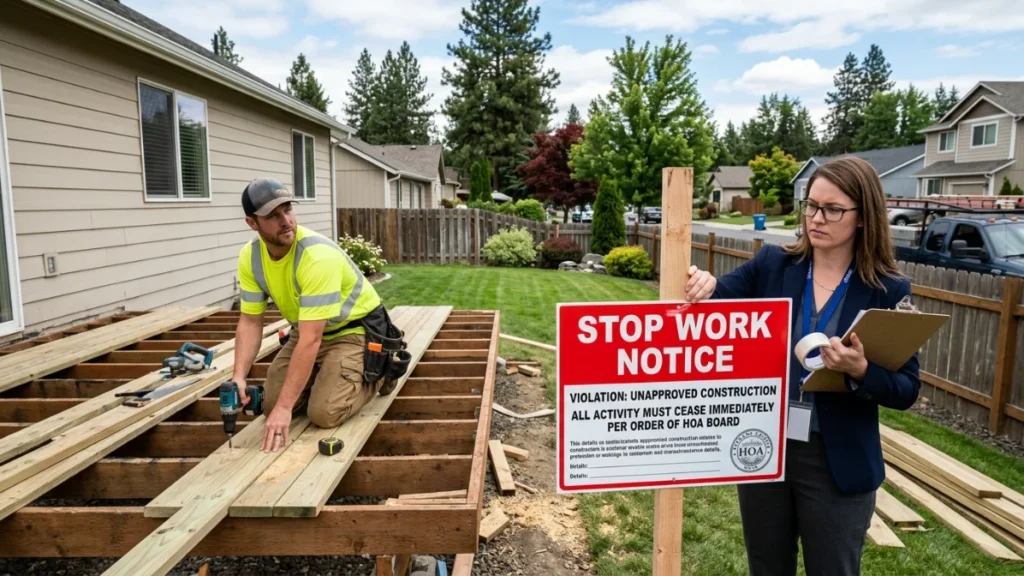
This is the highest-exposure mistake on this list. In a Spokane County HOA community, beginning exterior work that requires ARC approval, deck construction, fence installation, exterior repainting, siding replacement, without written approval in hand is a CC&R violation from the moment the first board goes up or the first brush touches the wall.
The enforcement sequence is consistent: written violation notice, then escalating daily fines until the violation is resolved, then a formal order to remove or reverse the work at the homeowner’s expense. Washington HOAs are not required by state law to cap daily fines at a specific amount, your CC&Rs set that limit, and many impose none. Homeowners in active Liberty Lake and Spokane Valley communities have accumulated four-figure fines before resolving the underlying violation.
Beyond fines, unapproved exterior changes create complications at the point of home sale. Title companies and buyers’ agents increasingly flag open HOA violations and unapproved improvements during due diligence. An unapproved deck or fence can delay or kill a closing. Resolving a violation after a buyer is under contract, under deadline, consistently costs more than resolving it before listing.
Mistake 2: Submitting an Incomplete ARC Package
This is the most common mistake, and the easiest to prevent with preparation. ARC committees cannot approve what they cannot evaluate. When an application arrives without a site plan, without product specification sheets, without the contractor’s Washington State licence number, or without photographs taken from the angles the committee needs, there is one outcome: the package is returned for completion at the next meeting cycle.
That next meeting cycle is typically 30 days away. One incomplete submission can push a spring project into summer, or a fall fence installation past the last comfortable working window in Spokane’s climate. During peak season, spring through early summer, ARC review queues are at their longest, and incomplete packages sit at the back of every one.
The items most commonly missing in Spokane County HOA submissions are: the contractor’s Washington State licence number and current insurance certificate, paint or stain colour codes listed generically rather than by brand and specific SKU, site plans without dimensions or setbacks marked, and photographs taken only from the homeowner’s backyard rather than from the street and neighbouring-lot views the committee uses to assess community impact.
Mistake 3: Getting HOA Approval But Skipping the Spokane County Permit
Many Spokane homeowners believe that ARC approval from the HOA is the only sign-off required before starting exterior work. It is not. HOA approval and a Spokane County building permit are two separate authorisations from two separate authorities with two entirely different scopes.
The HOA governs community aesthetics and standards: whether your new deck colour matches the approved palette, whether your fence height complies with the CC&Rs.
Spokane County Building Division governs structural safety and code compliance: whether your deck framing is engineered to handle Spokane’s snow loads, whether your footing depths meet the local frost-line requirement, whether electrical rough-in for an outdoor feature passes inspection.
For exterior projects with structural components, new deck construction, pergolas, fencing over 6 feet, accessory structures, structural siding changes, you will typically need to pull a Spokane County permit through the county’s Online Permit Center at spokanecounty.gov in addition to your ARC approval. Some Spokane County HOAs require county permit documentation to be attached to the ARC application.
Others expect it handled separately. Either way, skipping it creates two problems: the county can issue a mid-construction stop-work order, and an unpermitted structure creates a disclosure and insurance complication at resale that cannot be retroactively resolved cheaply. Our deck construction team confirms which permits apply before materials are purchased on every structural project.
Mistake 4: Hiring a Contractor Unfamiliar With HOA Documentation Requirements
A contractor who has never worked inside an HOA community does not know which details the ARC requires, which product specification formats Spokane County HOA management companies expect, or how to time a submission relative to the monthly meeting cycle.
When they prepare the application, or leave it to you, the result is typically an incomplete first submission, a 30-day delay, and a project schedule that slips before a nail is driven.
Preparing HOA submission packets that move through ARC review without re-submittals requires specific field knowledge: which photos to take and from which angles, how to annotate a site plan for ARC legibility, which manufacturer cut sheets to include and how to reference colour codes precisely, and how to format contractor documentation in the way management companies in active Spokane County HOA communities expect to receive it.
An HOA-experienced contractor reduces the gap between application submission and approval, and that compressed timeline is part of what you are paying for when you hire someone who has worked in these communities before.
The Right Way to Do It: Clean Guard’s Approval Checklist for Spokane HOA Projects
Avoiding the four mistakes above is straightforward when the process is followed in order. Here is the step-by-step approach Clean Guard Contracting uses on every HOA exterior project across Spokane County.
Step 1: Pull Your CC&Rs and Identify ARC Requirements Before Planning Begins

Your Covenants, Conditions, and Restrictions are the binding contract attached to your property. They define every rule governing your exterior project: approved colour palettes, permitted fence materials and heights, approved decking materials, setback requirements, and the exact submission format your specific ARC uses. Your CC&Rs and supplemental Architectural Guidelines are available through your HOA management company’s online portal or on request from the board.
Read the architectural modification section before choosing materials, colours, or contacting a contractor. A paint colour not on the approved palette cannot be approved regardless of how professional the submission is.
A decking material not on the approved list will require a variance request that adds weeks to the timeline. Fifteen minutes with your CC&Rs before project planning begins prevents the most common denial scenarios entirely.
If the language is ambiguous, contact your board or management company and request clarification in writing before submitting anything. Keep that response. It protects you if the interpretation is challenged during enforcement.
Step 2: What Your Contractor Needs to Submit to the Architectural Review Committee
A complete first submission is the single most important thing you can control in this process. Every item in the table below must be present before the packet goes in. One missing document pushes the review to the next monthly cycle.
When Clean Guard prepares this packet for our clients, we produce annotated photographs from the required angles, pull exact SKUs from manufacturer cut sheets, include our Washington State contractor licence and current insurance documentation, and confirm the county permit layer before a single item is submitted. Our clients do not manage this process, we do.
Step 3: Navigating Spokane County’s Online Permit Portal and the Fee-First Rule
For exterior projects requiring a Spokane County building permit, deck construction, pergolas, fencing over 6 feet, structural siding work, exterior electrical, applications go through Spokane County’s Online Permit Center at spokanecounty.gov.
Under the current fee-first rule, Spokane County requires payment of the plan review fee before the application enters the review queue. Upload all required submittal documents in PDF format and pay the plan review fee at submission. An application without fee payment does not move forward regardless of how complete the documentation is.
For standard residential deck permits, allow two to four weeks for review and approval during peak season (spring through early summer). For projects requiring structural engineering review, allow additional time. Some HOA boards in Spokane County require your county permit number listed on the ARC application itself. Others accept proof of application filing. Confirm which your HOA requires before submitting to either authority.
Practical sequencing: most experienced Spokane exterior contractors submit the ARC application and the county permit application in parallel rather than waiting for HOA approval before starting the permit process. Both run on independent timelines. Waiting for one before starting the other adds unnecessary weeks to the overall schedule. Our property maintenance team advises on project sequencing as part of every consultation for applicable projects.
Step 4: What to Do If the HOA Denies Your First Submission
A denial from the ARC is specific feedback on what needs to change, not the final word on your project. In Spokane County HOA communities, the most common denial reasons are: a proposed colour outside the approved palette, a material not on the approved list, a dimension or placement that violates setback requirements, or a missing document. Each of these is fixable.
When you receive a denial, request a written explanation that cites the specific CC&R provision or architectural standard that your proposal conflicted with. Do not resubmit the same package. Address the cited issue directly and confirm with the board or management company that your revision resolves the specific objection before refiling.
A targeted revision moves through the next review cycle cleanly. A guesswork resubmission does not.
If you believe a denial was applied inconsistently with how similar projects in your community have been treated, most HOAs have a formal appeals process outlined in their governing documents. Washington WUCIOA provides some statutory homeowner protections on architectural review decisions.
For disputes involving potential selective enforcement or CC&R interpretation questions, a brief consultation with a Washington HOA attorney is a worthwhile step before pursuing the appeal formally.
Don’t Pay Twice. Get It Right the First Time.
Every expensive HOA exterior outcome in Spokane County, the forced fence removal, the mid-construction stop-work order, the failed home-sale inspection, traces back to one of the four mistakes above.
A complete ARC submission, the right county permit pulled in parallel, and a contractor who has worked in Spokane HOA communities before turn a process that feels complicated into a predictable four-to-six week timeline with a clear approval at the end.
Clean Guard Contracting handles documentation, ARC submissions, and Spokane County permits for exterior projects across Liberty Lake, Deer Park, Spokane Valley, and surrounding communities. Nothing gets missed. Contact Clean Guard Contracting today for a free estimate on a project done right, approved, permitted, and built to last.