
Most people think property management maintenance is hard because of the work itself, like the frozen pipes, the roof leaks, the HVAC failures.
But that’s not actually the problem.
The real challenge is managing the chaos before repairs: a flood of tickets, demanding residents, slow vendors, and owners who escalate issues before you act. This complexity is the true test.
For property management companies in Spokane, maintenance gets overwhelming because everything hits at the same time.
You’re drowning because you’re stuck in reactive mode, dealing with unpredictable surges, poor communication, and no system to get ahead of the problems before they land in your queue.
This guide breaks down the 7 real maintenance challenges Spokane PM companies face and more importantly, the prioritization framework that helps you stop reacting and start controlling your maintenance operation.
The 7 Real Maintenance Challenges Spokane Property Management Companies Face
Here are the 7 maintenance challenges Spokane property management companies face and how to stay ahead of them.
1. Ticket Pileups From Sudden Freeze–Thaw Events
When Spokane drops 25–30 degrees overnight, PM companies don’t deal with “a frozen pipe.” They deal with 20–60 tickets hitting the portal before 9am, residents demanding immediate updates, owners calling for status checks, and contractors already booked by 8:30am.
Your team is stuck deciding which buildings get priority and which residents need temporary relocation. It’s not the burst pipe that kills you… it’s the volume, triage, communication load, and reputation risk it creates.
What helps: Portfolio-wide freeze-risk mapping, pre-freeze inspections for high-risk buildings, and contractors who reserve emergency capacity specifically for PM partners. This turns reactive firefighting into a manageable workflow.
2. Recurring Roof & Ice Dam Issues That Produce Cycles of Tenant Frustration
Roof leaks create multiple tickets, not one. A single ice dam can trigger separate requests for three different stains in three rooms, renters’ concern about musty smells, owners panicking about mold, and repeated follow-ups while waiting for a roofer’s availability.
Each roof issue becomes 5–12 touches across multiple systems: maintenance → vendor → residents → owners → rescheduling → documentation.
What helps: Winter roof monitoring for entire portfolios, attic moisture sensors so PMs get alerts before tenants do, and combined roof + interior repair cycles with one vendor instead of three. This eliminates duplicate tickets and endless follow-ups.
3. HVAC Failures That Turn Into Customer Service Crises
In Spokane heatwaves, HVAC failure causes residents to threaten lease breaks, call center overload, urgent pressure from owners, and multiple buildings going down simultaneously. Add wildfire smoke clogging filters twice as fast, and your team is juggling temporary solutions while contractors are booked out for five days.
Keeping residents calm and owners confident during a 100° heat wave is a retention crisis.
What helps: Proactive smoke-season maintenance plans, reserved PM-only emergency slots during heatwaves, whole-portfolio filter programs, and pre-summer performance testing for older buildings. This protects lease renewals, not just equipment.
4. Drainage & Foundation Issues That Create Liability and Owner Escalation
Poor drainage doesn’t create one maintenance request; it creates a chain reaction. Basement smell tickets, resident moisture concerns, owner anxiety about structural issues, emergency requests after storms, and liability exposure from walkway heaving.
These issues create owner distrust (“Why wasn’t this caught sooner?”) and renter dissatisfaction (“No one is fixing this fast enough”).
What helps: Seasonal drainage monitoring tied to your PM calendar, portfolio-wide grading assessments, and single-vendor handling of drainage + foundation + concrete repairs. This prevents owner panic and reduces liability exposure.
5. Older Multifamily Buildings Causing Multi-Unit Failures
PM companies manage large numbers of 60s–80s buildings. One plumbing issue can result in 6–12 units losing pressure, building-wide outages, simultaneous tickets, multiple rounds of resident messaging, and repeated call-backs when hidden corrosion isn’t addressed.
One problem becomes multiple dissatisfied residents and multiple owners demanding answers.
What helps: Riser-by-riser plumbing assessments, phased repipe plans that PMs can present to owners, building-wide shutoff coordination, and documentation packages with photos and reports for owner justification. This transforms emergency scrambling into structured planning.
6. Pest Intrusion Turning Into a Reputation Issue
In older Spokane buildings, pests don’t stay contained. They trigger waves of tenant pushback from adjacent units, fear-based messaging, owner concerns about habitability, and repeated service calls because root entry points aren’t fixed.
PM companies get blamed for slow action even when pest control is the bottleneck.
What helps: Sealing entry points after pest removal, structural patching to stop re-entry, and building-wide pest mapping so you solve the source, not the symptom. This cuts repeat tickets and negative resident sentiment.
7. Concrete & Parking Lot Damage Creating Safety and Lease Renewal Risks
Cracked walkways and lot deterioration create immediate safety concerns, trip/fall liability exposure, bad curb appeal that affects renewal rates, and owners questioning the asset’s long-term care.
This is about resident satisfaction, owner confidence, and insurance risk.
What helps: Seasonal concrete inspections tied to freeze-thaw cycles, bulk-rate resurfacing for entire portfolios, and drainage corrections to prevent re-damage. This keeps properties compliant and renewal-ready.
The Spokane Property Maintenance Prioritization Framework For PM Companies
When you manage 30, 300, or 3,000 doors, the hardest part of Spokane maintenance isn’t the repair itself. It’s deciding what actually needs attention today and what can safely wait.
Everything feels urgent to residents; everything becomes urgent during weather swings, owners escalate fast if communication lags, and contractors are booked out in the moments you need them most.
That’s why strong PM teams should use a simple decision-making model: The Spokane Property Maintenance Pyramid.
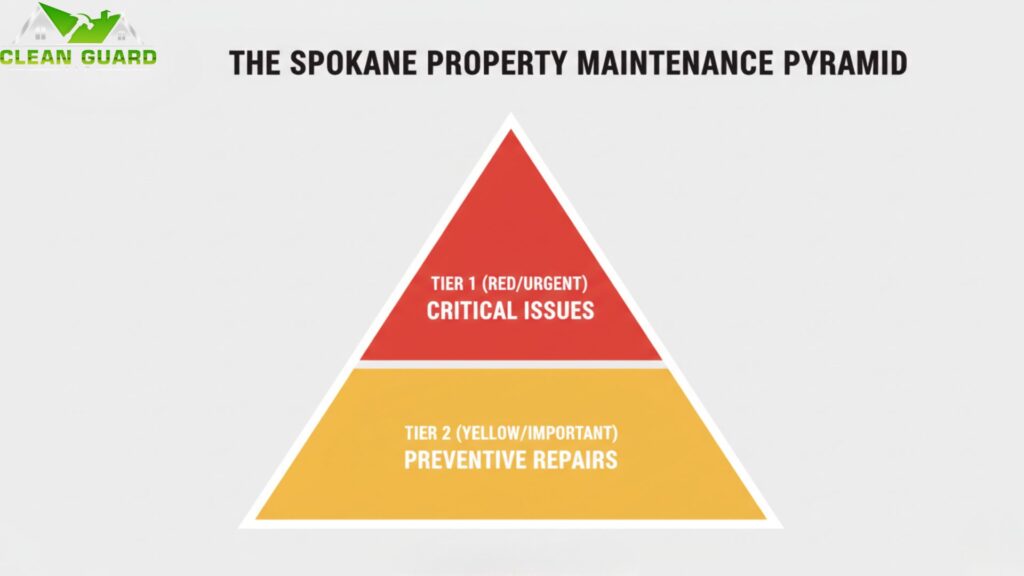
Tier 1: Critical Issues (Fix Immediately)
These are problems that threaten habitability, safety, or rapid property damage. These cause after-hours calls, owner escalation within minutes, potential relocation needs, and legal exposure if delayed.
Examples:
- Burst pipes affecting multiple units
- Roof leaks during freeze–thaw cycles
- HVAC failure during extreme cold or 100° heat
- Multi-unit plumbing outages
Why it matters: Delay equals negative reviews, habitability claims, and exponentially more workload for your team. PM companies that win here have contractors who hold emergency capacity for their portfolio.
Tier 2: Preventive Repairs (The PM Profit Protectors)
These are issues that don’t explode today but will explode at the exact worst time during a heatwave, freeze, or storm. Most of the money PM companies lose comes from ignoring this tier, not because repairs are expensive, but because it creates future ticket avalanches.
Preventive work is the difference between 8 HVAC tickets in a day versus 80 HVAC tickets in a week.
Examples:
- Pre-smoke-season HVAC tune-ups
- Gutter cleaning before the first snow
- Drainage correction to prevent foundation movement
- Pipe insulation in high-risk buildings
Why it matters: Every dollar spent in prevention saves $4–$8 in emergency repairs. But more importantly, it saves staff hours and tenant frustration. I know you don’t need less work, you need fewer unpredictable emergencies.
Staying Ahead of Spokane’s Maintenance Curve
For property management companies, maintenance in Spokane is about keeping your portfolio stable, your residents calm, your owners confident, and your team out of constant reaction mode.
Spokane makes that harder than most markets: older buildings with hidden issues, weather swings that spike your ticket queue, HVAC systems pushed past their limit, roofs that ice dam every winter, and a contractor pool that gets overwhelmed the same week you do.
But you don’t reduce maintenance overwhelm by working harder. You reduce it by partnering with contractors who prevent problems before they land in your system.
When you have a contractor who understands Spokane weather patterns, aging buildings, and PM workflows, everything changes:
- Fewer emergency tickets
- Clearer owner communication
- Less back-and-forth with residents
- Scheduled repairs instead of crisis management
- Better renewal rates
- A team that gets ahead instead of digging out
Your operations run smoother when problems get solved early, consistently, and with proactive planning…not last-minute scrambling.

Ready to Cut Your Maintenance Ticket Load in Half?
Cleanguard Contracting specializes in Spokane’s unique maintenance challenges and works directly with property management companies to create structured, proactive systems.
We know you need a partner who reduces your workload, not adds to it.
Our goal is simple: reduce your ticket volume, make your operations smoother, and help you stay ahead of Spokane’s maintenance curve.
Schedule your free consultation with Clean Guard Contracting Experts…we’ll walk your portfolio, identify your biggest risk areas, and show you exactly how we’d reduce your ticket load.
Let’s make your maintenance operation something you manage…not something that manages you.