
If you live in Spokane, your deck deals with more stress than you think. The freezing winters, the heavy snow, the hot, dry summers… they all beat on the wood day after day. And most homeowners don’t notice the early warning signs until the deck starts to feel “a little soft” or a railing wiggles more than it should.
Decks don’t fail all at once. They fail slowly… then suddenly.
And if you’re not looking in the right places, it’s easy to miss the signs that your deck is becoming unsafe.
In this guide, we’ll walk through the real warning signs your deck isn’t safe anymore, how Spokane’s climate speeds up damage, the exact issues that require repair vs. full replacement, and the simple checks you can do each season to keep your family safe.
The 7 Warning Signs Your Deck Isn’t Safe Anymore
Here’s what Spokane homeowners should look for, and why these issues happen faster here than in other parts of the country.
1. Soft, Spongy, or Splitting Boards
Walk across your deck and pay attention to how it feels under your feet. Soft spots aren’t just “old wood”. They’re wood that’s losing structural strength.
What homeowners usually miss is that rot doesn’t start on top. It starts underneath where snowmelt sits, airflow is low, and the sun never hits.
When it’s repairable:
A few isolated boards with no spread of rot.
When it’s replacement territory:
Multiple soft areas, deep splits, or boards flexing when stepped on. That means the structure underneath may be compromised.
2. Loose or Wobbling Railings
A wobbly railing is not a cosmetic issue. It’s one of the biggest liability risks you have on your property. It happens because of:
- Fasteners expand and contract during hot/cold swings
- Moisture freezes around hardware, loosening it
- Older decks were built with screws that no longer meet Spokane County standards
If a railing moves when you push on it, even slightly, treat it as a safety flag.
When to stop using the deck entirely:
If the railing wiggles at the post, not just the top rail. That’s a sign the attachment is failing.
3. Rot Around Post Bases & Joists
Rot is sneaky. It hides at the bottom of posts, the underside of joists, and anywhere moisture gets trapped. Why it’s worse here:
- Snow piles around post bases
- Ground moisture stays trapped during long, cold snaps
- Decks built before modern flashing rules are more vulnerable
If you can push a screwdriver into wood near the base with little resistance, there’s rot.
When to Replace:
Rot that spreads across multiple joists or affects structural posts.
4. Ledger Board Damage (The #1 Cause of Deck Collapses)
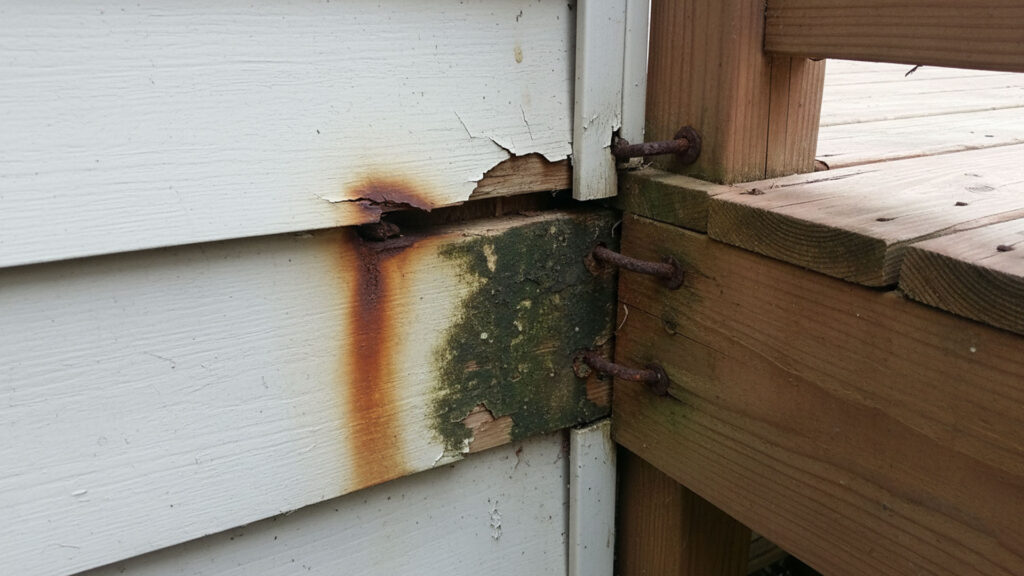
Most deck failures come from one place: the ledger board, which connects your deck to your house. If the ledger fails, the deck can pull away from the home and collapse outward.
Issues are:
- Many pre-2010 decks lack proper flashing
- Snow melt sits behind old siding
- Freeze-thaw cycles break down old nails and screws
Warning signs to look for:
- Gaps between the deck and house
- Rusted or undersized hardware
- Cracked or sagging areas along the connection
- Water stains or soft wood around the ledger
This is one of those situations where “I’ll check it in spring” isn’t smart. Ledger issues need urgent attention.
5. Rusty, Loose, or Undersized Hardware
Most older decks in Spokane weren’t built with today’s code-approved, corrosion-resistant fasteners. After 15–20 winters, you’ll see:
- Rust on bolts and screws
- Nails backing out
- Hangers bending
- Connectors losing grip
Snow load puts a huge strain on these parts. Once hardware weakens, the deck’s entire load path becomes unreliable. You can have strong wood sitting on failing hardware, and the whole deck is still unsafe.
6. Sinking or Leaning Footings
Spokane’s freeze heave is no joke. The soil expands in winter, contracts in spring, and shifts everything sitting on it. Signs your footings are failing:
- Posts leaning inward or outward
- Cracks around concrete piers
- Deck feels uneven or slopes slightly
- Gaps between support beams and posts
If snow sat heavily on your deck this winter, check your footings now. Movement here is a structural problem, not just an annoyance.
7. Fading, Cracking, and Warping
Most homeowners assume fading or warping is just cosmetic. But in Spokane, it often means the material is breaking down from UV exposure and temperature stress. This matters because:
- Cracks let moisture in → freeze expands it → wood splits deeper
- Warped boards can pull fasteners loose
- Severe fading means protective sealants have failed
Cosmetic damage becomes structural faster than people think. These are the deck signs you must consider to stay safe.
How Spokane’s Climate Wears Down Decks Faster
Let’s break down what’s actually happening to your deck every season.
Extreme Temperature Swings
Spokane can jump from 95°F summer days to near-freezing nights. Wood expands, contracts, expands again… and eventually gives up. You’ll see:
- Hairline cracks
- Loose fasteners
- Boards are slowly pulling away
These tiny shifts add up fast, especially on decks over 10–15 years old.
Freeze–Thaw Cycles (The Silent Deck Killer)
When snow melts during the day and freezes at night:
- Water seeps into cracks
- It freezes and expands
- The cracks grow deeper
- Repeat… 40+ times each winter
That’s why rot often shows up underneath boards before you ever see it on top.
High UV Exposure at This Elevation
Spokane’s summer sun hits harder than most people think. UV breaks down sealant, stain, and composite finish, and wood fibers.
That’s why a deck can look “sun-bleached” on the surface but actually be losing protective layers that keep moisture out. Once the top layer fails, the real damage begins.
Dry Summers + Moist Winters
This mix is rough. Dry heat pulls moisture out of wood too fast, making it brittle, and then wet winters push moisture back in and making it expand. That back-and-forth cycle is where cracking, cupping, and warping come from.
Snow Load Stress
A heavy winter can put tens of thousands of pounds on an older deck. Especially on flat or low decks, decks built before updated snow load codes, and homes in places like South Hill, Nine Mile Falls, or Liberty Lake, where snow stacks higher.
Even if the deck “looks fine” in spring… the hidden stress on fasteners and joists can leave lasting damage.
Wind & Storm Exposure
Spokane gets more high-wind days than most inland cities. If your deck faces the west or is exposed on a hill, this happens even faster. That’s why Spokane decks need more proactive care than decks in places with stable climates.
Repair or Replace? How to Tell What A Deck Needs
Most homeowners don’t know when a deck just needs a tune-up… and when it’s officially time to stop putting money into repairs.
And honestly? It’s not your fault. Spokane’s climate makes decks age in unpredictable ways. A deck can look “okay” from above and be failing underneath. Here’s the simplest way to tell the difference without guessing.
When You Can Repair Your Deck
You’re usually safe with repairs when the issues are:
- Localized
- Surface-level
- Not affecting the load-bearing structure
If the structure hasn’t been hit hard by freeze–thaw cycles or long-term moisture, repairs go a long way.
Repairs make sense when the deck is:
- Under 15 years old
- Built with pressure-treated lumber
- Passing a basic structural check
- Still aligned and level
If the bones are good, repairing can extend their life by years. So, choose your deck construction professionals wisely.
When It’s Time to Replace the Deck
There’s a point where repairs stop being cost-effective and, honestly, stop being safe. Replacement becomes the smarter move when you see:
- Rot spreading across joists or beams
- Posts showing deep decay
- Footings sinking or leaning
- Ledger board separation
- Widespread cracking or warping
- Rusted hardware throughout the structure
- Any major load-bearing issue
In Spokane, an older deck can look “fine” and still be dangerously out of code. That’s why replacement often ends up being the safer, more economical option long-term.
ROI Considerations
Replacing a deck isn’t just a cost; it’s one of the most reliable upgrades you can make. Here;
- Deck replacements often deliver a 65–80% ROI on resale
- Homes with new decks sell faster in competitive neighborhoods
- Buyers look for modern materials that handle Spokane’s weather
- An unsafe deck can lower appraisal value or trigger inspection problems
And if you’re planning to stay in the home? A safe, updated deck is simply peace of mind.
Insurance & Liability
If someone is injured on a deck that shows visible signs of neglect, insurance may deny the claim. That includes:
- Loose rails
- Rot
- Ledger failure
- Known structural issues
Replacing a failing deck is about protecting yourself.
Your Seasonal Deck Safety Measures (Spring & Fall) You Shouldn’t Ignore
Here’s a simple checklist you can run through twice a year.
Spring Checklist (Right After Snow Melt)
Walk through these items:
1. Check for soft or spongy boards
Snowmelt sits on the surface for weeks. Press with your foot or a screwdriver. Soft = moisture damage.
2. Look for lifted or rusted hardware
Freeze–thaw cycles push screws up and rust nails faster.
3. Inspect railing post connections
Winter expansion can loosen brackets and create a wiggle you didn’t notice in the fall.
4. Scan for ledger board gaps
If you see separation, staining, or sagging, call a pro. That’s the danger zone.
5. Examine footings and posts
Snow load pressure can tilt or sink posts slightly. Small movements now become big issues later.
6. Test stairs for wobble or uneven rise
Snow shifts soil underneath, especially on older homes.
7. Check for mold, mildew, or dark staining
This often shows up near shady areas or under planters.
Fall Checklist (Before Freezing Temps Return)
Fall is about prepping your deck to survive winter without major damage.
1. Clean debris between boards
Leaves trap moisture. Moisture freezes. Wood cracks.
2. Look for existing small cracks or splits
These expand aggressively once the freeze–thaw season kicks in.
3. Inspect stain or sealant wear
If water doesn’t bead on the surface, protection is gone.
4. Tighten loose fasteners
Cold shrinks metal. Loose hardware now = movement all winter.
5. Check under the deck
Look for rot, animals, pooling water, or sagging joists.
6. Confirm railings are secure
Windstorms hit hard in Spokane. Weak railings don’t make it through December.
7. Clear anything heavy
Planters, furniture, and grills add thousands of pounds during the snow season.
When to Stop and Call a Professional
If you notice any of these, pause the DIY inspection and get a pro involved:
- Wood, you can push a screwdriver through
- Posts leaning or shifting
- Large ledger gaps
- Wobbly railings at the base
- Deep cracks or cupping across many boards
- Sinking concrete footings
- Rusted hardware across multiple areas
If these issues are clear, don’t use the deck until someone looks at them professionally.
Stay Safe & Comfortable Under Your Deck
If your deck is starting to show signs of age… or you’ve spotted something in this guide that doesn’t feel right… trust that instinct. Small issues turn into expensive ones fast. And structural problems almost never fix themselves.
This doesn’t have to be stressful. You don’t have to become a deck expert. You just need someone who knows Spokane weather and Spokane homes.
If you want a clear answer on whether your deck is safe or what it needs, Cleanguard Contracting, who have 10+ years of experience, is here for you.
If you’re even 1% unsure about your deck, we’ll take a look, no pressure, no sales pitch, no obligation. So, schedule a free inspection with Cleanguard Contracting.