
For most Spokane decks, 4-sided capped composite is the better long-term material. Wood still makes sense in specific situations, which we will name. What determines whether either material actually holds up is not just the product you choose, but also how it is built.
This guide gives you the material comparison, the installation details that matter in Spokane’s climate, and a straight answer on cost so you can make a confident decision.
Composite vs. Wood Decking: Which Is Better for Spokane Homes
The table below maps every key factor to real product tiers and the Spokane climate stress each one faces. Read across the row for the factor that matters most to you.
| Factor | Wood | Composite | Spokane Stressor |
| Upfront cost (materials) | $3-8/sqft (PT pine / cedar) | $9-16/sqft (Trex, TimberTech, Fiberon) | Budget — install day |
| 10-year total cost | Higher — staining, sealing, board swap | Lower — cleaning only, no refinishing | Long-term ownership math |
| Lifespan (Spokane) | 10-15 yrs with full upkeep | 25-30+ yrs, warranty-backed | Freeze-thaw degradation |
| Maintenance cadence | Sand + seal every 1-2 yrs | Soap-and-water 1-2x/year | Time and labor cost |
| Freeze-thaw resistance | Vulnerable — water enters grain | 4-sided cap = zero water entry | 23°F-88°F seasonal swing |
| Heat & UV behavior | Dries, grays, splinters — needs sealer | UV-pigmented cap; darker boards run hot | Spokane’s 90°F+ summer sun |
| Mold & snowmelt | High risk without sealed surface | Non-porous cap repels moisture | 40+ in. annual snowfall |
| Install complexity | Standard — any framing crew | Requires correct gapping + hidden fasteners | Thermal expansion tolerance |
What Makes a Deck Last Longer in Spokane’s Climate
Here’s the secret to lasting your deck…
Is Capped Composite Decking Better for Spokane Weather?
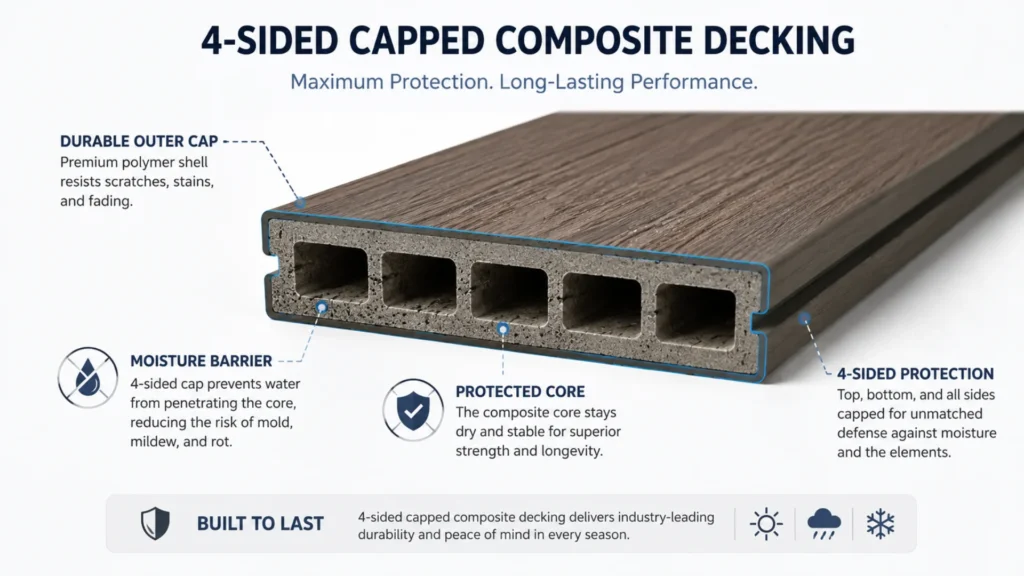
Not all composite decking behaves the same way in a freeze-thaw climate. Uncapped composite has an exposed wood-fiber core that absorbs moisture the same way natural wood does; water enters, freezes, expands, and opens cracks. In Spokane’s winters, that cycle repeats 18 or more times a month through January and February. Uncapped composite priced attractively is a false economy here.
4- sided capped composite (polymer shell on all four sides) blocks water entry completely. Because no moisture reaches the core, there is nothing to freeze. Boards hold their dimensions through Spokane’s full 23°F to 88°F seasonal swing without warping, splintering, or raising fasteners. Specify a 4-sided cap, not a 3-sided. The extra cap on the bottom edge is what defeats moisture wicking from below when snowmelt sits under the deck structure.
Which Composite Decking Is Best for Spokane Homes
Entry-level capped composite (Trex Select, TimberTech Terrain, Fiberon Paramount) runs approximately $9-11 per square foot in materials. These boards carry 25-year warranties covering fade and stain, and perform reliably in Spokane’s climate. They are the right choice for most standard residential decks.
Premium composite lines (Trex Transcend, TimberTech Azek, Fiberon Sanctuary) run $13-16 per square foot and add deeper embossing, heat-mitigating technology for south-facing Spokane decks in full summer sun, and scratch resistance for households with heavy foot traffic or pets. If your deck faces southwest and bakes from noon onward, the heat-mitigating surface on premium boards is a practical upgrade, not a luxury.
What Is the Best Wood Decking for Spokane Weather
Pressure-treated pine (ground contact rated) is the most affordable wood option at $3-6 per square foot. It handles Spokane conditions if properly sealed before winter and re-sealed every one to two years.
Cedar offers natural rot and insect resistance without chemical treatment, and it weathers more gracefully, but it requires the same sealing discipline in Spokane’s climate. Thermally modified wood (Accoya or similar) has significantly improved moisture resistance and dimensional stability, but it is priced comparably to entry composite, at which point most homeowners choose composite for the maintenance savings.
What Installation Factors Affect Deck Lifespan in Spokane
Most failed Spokane decks we replaced got the installation wrong, not just the material. Here is what the build must include for either material to perform:
• Board gapping for thermal expansion: Composite gapping depends on installation temperature. Installing in 40°F weather requires a larger gap than installing in 70°F weather because the boards will expand further in summer. Follow manufacturer gap tables; most crews who skip this produce boards that buckle or gap excessively by the second summer.
• Joist flashing tape: Apply self-adhesive flashing tape to the top surface of every joist before laying boards. This is the single most effective rot prevention step for wood-framed decks. Snowmelt and rain trapped between the board and joist destroy untaped framing within five to seven years in Spokane.
• Hidden fasteners vs. face-screwing: Hidden fastener systems (Trex Hideaway, Camo Edge, universal clip systems) eliminate the surface penetration points that allow water into board edges. Face-screwed decks with composite expand and contract around the screw shanks, loosening over freeze-thaw cycles and producing raised fasteners by year four. Use hidden fasteners on all composite installations.
• Ground clearance and drainage: Maintain a minimum of 12 inches of clearance between the deck frame and grade. In Spokane, snowmelt accumulates below the deck structure through March and April. Poor clearance taps moisture against posts and rim joists, the most common source of structural rot in the decks we replace.
• End-sealing cut wood: Every field-cut end on pressure-treated lumber opens the treated core to moisture. Seal cut ends immediately with an approved end-cut preservative. This step is skipped on roughly half the wood decks we inspect, and it accounts for a disproportionate share of rot damage at stair stringers and rim boards.
When Should You Choose Wood Instead of Composite Decking?
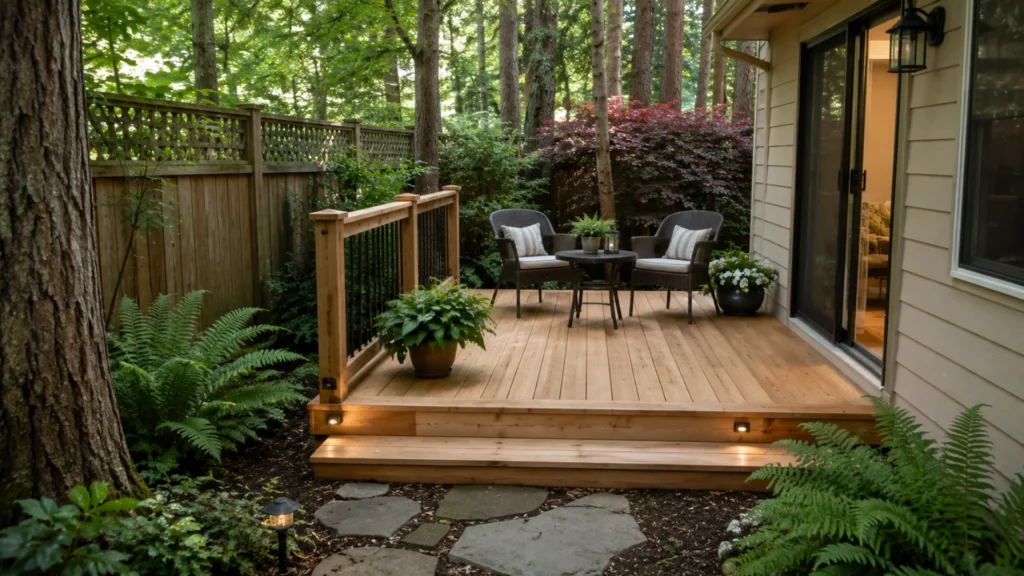
Wood is not the wrong choice; it is the wrong choice for the homeowner who will not maintain it. Here is when it is the right call:
• Tight upfront budget with a clear maintenance plan: If your budget ceiling is firm at the material cost level and you are genuinely committed to sealing every 12 to 18 months, pressure-treated wood built on a properly flashed frame performs well in Spokane for 10 to 15 years.
• Smaller, shaded decks on north-facing exposures: Decks that see limited direct sun and dry quickly avoid the worst of Spokane’s UV degradation. A well-built 200-square-foot cedar deck on a north-facing elevation is a reasonable long-term investment.
• Owners who want natural grain and will commit: Cedar’s natural grain and weathering character is genuinely preferred by many homeowners. If that aesthetic matters and the maintenance commitment is real, cedar remains a solid Spokane choice. The keyword is real; one missed sealing season in Spokane’s climate accelerates deterioration faster than most homeowners expect.
What wood should not be chosen for: large decks with full sun exposure, homeowners with limited time for annual maintenance, or decks expected to last 20-plus years without a rebuild.
Need Professional Deck Installation or Repair in Spokane?
The material comparison is one decision. Getting the build right, joist flashing, proper gapping, hidden fasteners, drainage, is what determines whether your deck actually survives Spokane weather for 25 years or needs replacing in 12.
Clean Guard Contracting builds and repairs decks across Spokane, Spokane Valley, Liberty Lake, and Deer Park, and we handle material selection as part of every consultation. Contact Clean Guard today for a free estimate and a deck built to last.
FAQs
- Does composite decking get hot during Spokane summers?
Yes. Dark-colored composite boards exposed to direct sunlight can become uncomfortable under bare feet during Spokane’s hottest days. If heat is a concern, choose lighter-colored boards or premium lines with heat-mitigating technology, such as Trex Transcend Lineage or TimberTech Terrain. While wood generally stays slightly cooler, it can dry out, crack, and splinter without regular sealing and maintenance.
- Can a wood deck handle Spokane’s winter snow loads?
Yes. A properly engineered and code-compliant wood deck can safely support Spokane’s snow loads. The bigger concern is moisture damage after the snow melts. Water that sits on an unsealed wood surface can lead to rot, mold, and premature deterioration. Regular sealing before winter is essential for long-term performance.
- How long does a wood deck last in Spokane?
A well-built and consistently maintained wood deck typically lasts 10 to 15 years in Spokane’s climate. However, skipping routine sealing or staining can significantly reduce its lifespan. Composite decking often lasts 25 to 30 years or more with minimal maintenance, making it a popular long-term option.
- Is composite decking worth the higher upfront cost?
For many Spokane homeowners, yes. While composite decking costs more initially, it eliminates the recurring expenses of staining, sealing, sanding, and frequent board replacement. Over a 10-year period, many homeowners find that composite decking costs less to own and maintain than wood while also delivering strong resale value.
- Which decking material is better for Spokane’s freeze-thaw cycles?
Composite decking, especially 4-sided capped composite, generally performs better in freeze-thaw conditions because it resists moisture absorption. Wood can perform well, too, but only when properly sealed and maintained. Without regular upkeep, wood is more susceptible to cracking, warping, and moisture-related damage.
- What is the best decking material for long-term durability in Spokane?
For homeowners looking for the longest lifespan with the least maintenance, 4-sided capped composite decking is typically the best choice. It resists moisture, fading, staining, mold growth, and freeze-thaw damage while requiring only occasional cleaning.